Table of Contents
Classic Steak au Poivre with Truffled Frites – A Bistro Classic Reimagined
I still remember the first time I tasted a proper steak au poivre — it was during my culinary training in Paris, at a tiny bistro tucked away on a cobblestone street in the 6th arrondissement. The waiter set down a cast-iron skillet with a sizzling peppercorn-crusted filet, and the aroma of cracked black pepper and cognac rising through a swirl of cream was absolutely intoxicating. That moment shaped my understanding of what a truly great steak au poivre recipe could be: bold, elegant, and deeply comforting. This version, paired with crispy truffled frites, is the one I now make in my New York City kitchen whenever I want to transport myself back to that Parisian evening.
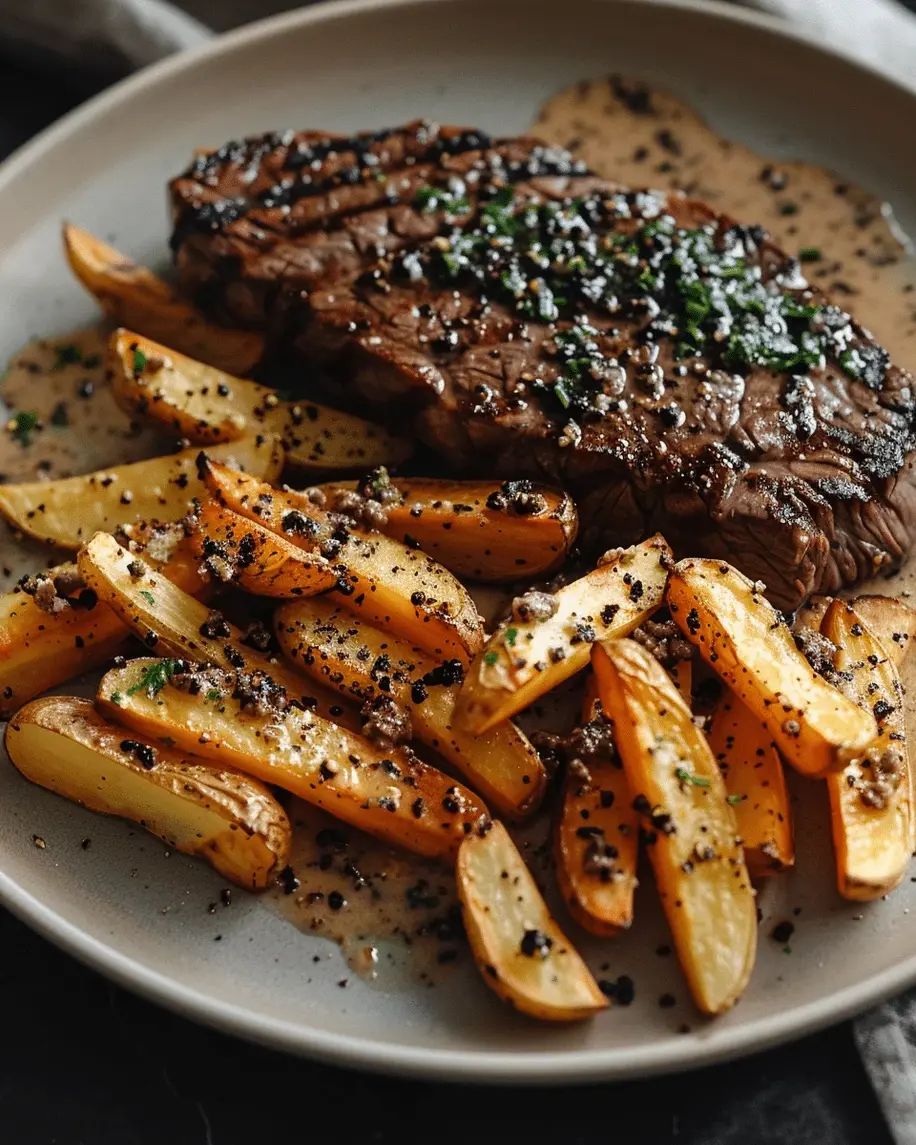
The beauty of this dish lies in the contrast — the fiery kick of freshly cracked peppercorns mellowed by a silky, cognac-spiked cream sauce, all set against the earthy, luxurious aroma of truffle oil on golden, twice-fried potatoes. Each bite of the steak is tender and rich, with a crust that gives way to a juicy medium-rare center. The frites are impossibly crisp on the outside and fluffy within, kissed with truffle oil and fresh parsley. It’s the kind of meal that feels both special and approachable, whether you’re cooking for a date night or simply treating yourself to something extraordinary on a Tuesday evening.
What sets my classic steak au poivre apart is the technique I honed in Paris and the little touches I’ve added over the years — like letting the peppercorns rest on the steak before searing so the flavor really penetrates, and using a touch of Dijon mustard in the sauce to brighten the richness. I also insist on double-frying the frites for that perfect crunch, a trick I picked up from a frites stand in Brussels. In this post, I’ll walk you through every step, share my best pro tips, and help you avoid the common pitfalls so you can nail this bistro classic at home. Let’s get cooking.
Why This Classic Steak au Poivre Recipe Is the Best
The Flavor Secret — This isn’t just any peppercorn steak; it’s a carefully balanced dish where every element sings. I crack the peppercorns by hand (a mortar and pestle from my mother’s Moroccan kitchen does the trick beautifully) so you get both coarse pieces for texture and finer bits for even heat. The sauce is built on real cognac — none of that watery brandy — and finished with cream and a spoonful of Dijon that cuts through the richness just enough. It’s the same technique I learned at Le Cordon Bleu, but with a warmth that comes from years of cooking for people I love.
Perfected Texture — The steak develops a deep, dark crust thanks to a screaming-hot cast-iron skillet and a butter-olive oil combo that prevents burning while encouraging browning. I flip the steak only once and let it rest religiously — that’s non-negotiable. The frites go through a double-fry process: first at 325°F to cook through, then at 375°F to crisp up. The result is a crust that shatters when you bite into it, giving way to a fluffy interior that soaks up the truffle oil like a dream.
Foolproof & Fast — Despite its elegant reputation, this peppercorn steak with fries comes together in under an hour, and much of that is hands-off time while the oil heats or the steak rests. I’ve designed the instructions to be crystal clear, with visual cues at every stage so you know exactly what to look for — whether it’s the shimmer of the butter or the crackle of the peppercorns. Even if you’ve never made a French cream sauce before, you’ll nail it on your first try.
Steak au Poivre Recipe Ingredients
I source my beef from a butcher at the Union Square Greenmarket in NYC, where I can see the marbling and ask for a 1½-inch cut. The truffle oil I pick up from a little Italian specialty shop in Chelsea Market. There’s something about choosing each ingredient with care that makes the final dish taste even better — a lesson I learned watching my mother select spices in the medina of Marrakech.
Ingredients List
For the Steak au Poivre:
- 2 (8-ounce) beef tenderloin steaks (filet mignon), about 1½ inches thick
- 2 tablespoons whole black peppercorns, coarsely cracked
- 1 teaspoon kosher salt
- 2 tablespoons unsalted butter
- 1 tablespoon olive oil
- ¼ cup cognac or brandy
- ½ cup heavy cream
- 1 tablespoon Dijon mustard
For the Truffled Frites:
- 2 large russet potatoes, peeled and cut into thin matchsticks
- Vegetable oil, for deep-frying
- 2 tablespoons truffle oil
- 1 tablespoon finely chopped fresh parsley
- Salt, to taste
Ingredient Spotlight
Beef Tenderloin: This is the king of cuts for steak au poivre recipe — incredibly tender, with a buttery texture that stands up beautifully to the bold peppercorn crust. Look for steaks with even thickness and good marbling. Prime grade is ideal, but Choice works wonderfully too. If you can’t find tenderloin, a thick-cut ribeye or sirloin steak will also work, though expect slightly more chew.
Whole Black Peppercorns: Please, do not use pre-ground pepper here. The entire character of this dish depends on freshly cracked peppercorns. I use Tellicherry peppercorns for their bold, aromatic heat. Crack them just before using — a mortar and pestle gives you the most control over the size of the pieces.
Cognac: A good-quality cognac or brandy adds depth and a subtle fruitiness that balances the cream and pepper. I use a VSOP cognac from a small producer. If you don’t have cognac, a good bourbon or even Armagnac can substitute, but avoid anything too sweet or flavored.
Truffle Oil: This is what takes the frites from ordinary to unforgettable. Look for a truffle oil that lists real truffles in the ingredients, not just synthetic flavoring. A little goes a long way — 2 tablespoons is plenty for two generous servings. White truffle oil is milder and more elegant; black truffle oil has a stronger, earthier flavor.
| Original Ingredient | Best Substitution | Flavor / Texture Impact |
|---|---|---|
| Beef tenderloin | Ribeye or sirloin (thick-cut) | More beefy flavor, slightly less tender; adjust cooking time |
| Cognac | Bourbon or Armagnac | Bourbon adds a sweeter, smokier note; Armagnac is closer in flavor |
| Heavy cream | Crème fraîche or half-and-half (thickened with 1 tsp cornstarch) | Crème fraîche adds tang; half-and-half yields a thinner sauce |
| Truffle oil | Olive oil + 1 tsp truffle zest or finely chopped truffle (if available) | Milder truffle aroma; still delicious |
| Russet potatoes | Yukon Gold potatoes | Slightly creamier interior; slightly less crisp exterior |
How to Make Classic Steak au Poivre — Step-by-Step
Trust me when I say this: if you can sear a steak and stir a pan sauce, you can absolutely make this classic steak au poivre. I’ve broken it down into clear steps with all the little details that make the difference between good and unforgettable.
Step 1: Prepare the Frites
Soak the potato matchsticks in a large bowl of cold water for at least 30 minutes. This removes excess starch and is the secret to extra-crispy frites. Drain and pat completely dry with paper towels — any moisture left will cause the oil to splatter dangerously.
⚠️ Common Mistake to Avoid: Skipping the soak or not drying the potatoes thoroughly. Wet potatoes lead to soggy, greasy frites and dangerous oil splatters. Take the extra few minutes — your frites will thank you.
Step 2: First Fry the Potatoes
Heat about 2 inches of vegetable oil in a deep heavy pot or Dutch oven to 325°F (163°C). Working in batches to avoid crowding, fry the potatoes for 3-4 minutes until just tender but not browned. They should look pale and floppy. Remove with a slotted spoon and drain on paper towels. This is the “blanch” fry that cooks the interior.
💡 mia’s Pro Tip: Use a deep-fry or candy thermometer to maintain the oil temperature exactly. If the oil is too cool, the potatoes absorb oil; if too hot, they brown before the inside is cooked. 325°F is your sweet spot for the first fry.
Step 3: Crust the Steaks
Press the cracked peppercorns evenly onto both sides of each steak, pressing gently to adhere — you want a nice even coating, not a thick crust that will fall off. Season both sides with kosher salt. Let the steaks sit at room temperature for 10 minutes so the pepper flavor starts to penetrate.
Step 4: Sear the Steaks
In a large heavy skillet (preferably cast iron), heat the butter and olive oil over medium-high heat until the butter is melted and shimmering — the foam will subside. Add the steaks and cook for 4-5 minutes per side for medium-rare, or until the internal temperature reaches 130-135°F. Resist the urge to move the steaks around; let them form a deep, beautiful crust. Transfer to a plate and tent loosely with foil.
⚠️ Common Mistake to Avoid: Overcrowding the pan or flipping the steak too often. If the pan is crowded, the steaks steam instead of sear. Flip only once for the best crust development.
Step 5: Make the Sauce
Pour off excess fat from the skillet, leaving about 1 tablespoon behind. Remove the skillet from the heat momentarily, then add the cognac carefully — it may flame up, so stand back. Return to the heat and scrape up any browned bits (the fond) from the bottom of the pan with a wooden spoon. Cook for 30 seconds, then stir in the heavy cream and Dijon mustard. Simmer for 2-3 minutes until the sauce thickens slightly and turns a warm, caramel color. Season with salt to taste.
💡 mia’s Pro Tip: To avoid a fiery flare-up when adding the cognac, remove the skillet from the heat for a moment and pour the cognac in slowly, then return to the heat. If it does flame, let it burn off naturally — it adds a wonderful depth of flavor.
Step 6: Finish the Frites
Increase the oil temperature to 375°F (190°C). Re-fry the blanched potatoes in batches for 2-3 minutes until golden brown and incredibly crispy. Drain on paper towels, then toss immediately in a bowl with the truffle oil, parsley, and a generous pinch of salt. The heat from the frites will help the truffle oil aroma bloom.
💡 mia’s Pro Tip: Toss the frites with the truffle oil while they’re still hot from the fryer — the warmth helps the truffle flavor infuse into every crevice. Serve immediately for maximum crispness.
Step 7: Plate and Serve
To serve, place each steak on a warm plate and spoon the peppercorn cream sauce generously over the top. Pile the truffled frites alongside. Garnish with a sprinkle of fresh parsley and perhaps a pinch of flaky sea salt on the steak. Serve immediately — this dish waits for no one.
| Step | Action | Duration | Key Visual Cue |
|---|---|---|---|
| 1 | Soak and dry potato matchsticks | 30 mins (soak) | Water turns cloudy; potatoes are fully dry before frying |
| 2 | First fry potatoes at 325°F | 3–4 mins | Pale, tender, not browned |
| 3 | Crust steaks with cracked pepper | 2–3 mins | Even coating, peppercorns adhere firmly |
| 4 | Sear steaks in butter and oil | 8–10 mins total | Deep brown crust; internal temp 130°F |
| 5 | Make cognac cream sauce | 3–4 mins | Sauce thickens and turns warm caramel color |
| 6 | Second fry frites at 375°F | 2–3 mins | Golden brown, crispy, sizzling |
| 7 | Plate and serve | 2 mins | Sauce coats the steak; frites glisten with truffle oil |
Serving & Presentation
When I serve this steak with truffle fries in my NYC apartment, I like to plate it with a bit of theatre. I use warm dinner plates (pop them in a 200°F oven for 5 minutes) so the steak stays hot and the sauce stays silky. The steak goes in the center, napped generously with the peppercorn cream sauce, and the frites are piled high on one side — never underneath, so they stay crisp. A final sprinkle of flaky sea salt and a tiny pinch of fresh cracked pepper over the top ties it all together.
For a truly memorable presentation, I sometimes add a small handful of peppery arugula dressed with lemon juice on the side — it cuts through the richness and adds a vibrant green pop. In the summer, I might swap the arugula for a simple tomato and shallot salad with a sherry vinaigrette, a nod to my mother’s love of bright, acidic flavors alongside rich food.
This dish pairs beautifully with a full-bodied red wine like a Côtes du Rhône or a Malbec, but honestly, a good craft cocktail with rye whiskey also works wonders. If you’re feeding a crowd, double the recipe and use a large skillet — just don’t crowd the pan. Cook the steaks in two batches if needed, then make the sauce in the same pan to capture all those delicious browned bits.
| Pairing Type | Suggestions | Why It Works |
|---|---|---|
| Side Dish | Arugula salad with lemon, roasted asparagus, or haricots verts | Bright acidity and freshness balance the rich cream sauce |
| Sauce / Dip | Extra cognac cream sauce, aioli for the frites, or Dijon mustard | Adds layers of flavor and lets diners customize each bite |
| Beverage | Côtes du Rhône, Malbec, or a rye whiskey cocktail | Bold flavors stand up to the peppercorn and truffle |
| Garnish | Flaky sea salt, fresh parsley, a twist of lemon zest | Adds freshness, texture, and visual appeal |
Make-Ahead, Storage & Reheating
Between recipe development for my blog and running around NYC, I rely on make-ahead strategies to keep meals like this steak au poivre recipe achievable on busy weeknights. The good news: the frites can be partially prepped ahead, and the steak sauce stores beautifully. Here’s my system.
| Method | Container | Duration | Reheating Tip |
|---|---|---|---|
| Refrigerator | Airtight container (steak and sauce together) | 3 days | Reheat steak gently in a low oven (300°F) for 8-10 mins; reheat sauce separately on stovetop |
| Freezer | Freezer-safe bag or container (sauce only; steak does not freeze well) | 2 months | Thaw overnight in fridge; reheat gently and whisk in 1 tbsp cream to restore texture |
| Make-Ahead | Blanched frites on a baking sheet in the fridge, uncovered | 1 day in advance | Finish with the second fry just before serving — only 2-3 mins |
For reheating leftover steak, I never use the microwave — it toughens the meat and breaks the sauce. Instead, slice the steak against the grain and warm it gently in a skillet with a splash of beef broth or cream, stirring occasionally until just heated through. The frites, sadly, don’t re-crisp well, so I recommend making only as many as you’ll eat. But if you have leftovers, chop them up and toss them into a breakfast hash with eggs — that’s a happy accident I discovered one Sunday morning.
Variations & Easy Swaps
One of the things I love about this classic steak au poivre is how adaptable it is. Over the years, I’ve developed several variations that honor the original while opening it up to different tastes and dietary needs. Here are my favorites.
| Variation | Key Change | Best For | Difficulty Impact |
|---|---|---|---|
| Moroccan Spiced Steak | Add 1 tsp ras el hanout to the peppercorn crust | Adventurous home cooks who love warm spices | Easy — no change in technique |
| Dairy-Free Version | Use coconut cream (full-fat) and vegan butter | Dairy-free or lactose-intolerant guests | Easy — slight coconut flavor in sauce |
| Pork Tenderloin au Poivre | Substitute 1 lb pork tenderloin for beef | A more budget-friendly weeknight option | Easy — cook to 145°F internal temp |
Moroccan Spiced Steak au Poivre
This variation is very close to my heart — it’s the version I make when I’m missing my mother’s kitchen in Morocco. I mix 1 teaspoon of ras el hanout (a fragrant North African spice blend with cumin, coriander, cinnamon, and cloves) with the cracked peppercorns before pressing them onto the steak. The warm, floral notes of the ras el hanout meld beautifully with the cognac cream sauce, creating a bridge between my French training and my Moroccan roots. Serve it with couscous instead of frites for a truly cross-cultural meal.
Dairy-Free Steak au Poivre
I developed this version for a close friend who’s dairy-free, and honestly, it’s so good that I sometimes make it by choice. Swap the butter for a high-quality vegan butter (I like Miyoko’s European Style Cultured Vegan Butter) and replace the heavy cream with full-fat coconut cream from a can — the kind that solidifies at the top. The sauce will have a subtle coconut note that actually pairs surprisingly well with the truffled frites. Whisk in 1 teaspoon of cornstarch slurry if you need extra thickening, as coconut cream is thinner than dairy cream.
Pork Tenderloin au Poivre
When beef prices are high or I just want something a little lighter, I turn to pork tenderloin. It’s lean, tender, and takes beautifully to the peppercorn crust. The key difference is cooking temperature: pork should reach 145°F for safe consumption, so I cook it for about 4-5 minutes per side depending on thickness. The sauce remains exactly the same — the cognac and cream are just as lovely with pork as they are with beef. This version has become a regular on my weeknight rotation, especially in the fall when I serve it with roasted apples on the side.
What is the best cut of beef for making Classic Steak au Poivre?
The best cut for Classic Steak au Poivre is beef tenderloin, specifically filet mignon, cut about 1½ inches thick. Tenderloin is incredibly tender and has a mild, buttery flavor that lets the peppercorn crust and cognac cream sauce shine. However, you can absolutely use other cuts — a thick-cut ribeye offers more marbling and beefy flavor, while a boneless sirloin is a more budget-friendly option that still delivers great results. Whatever cut you choose, look for steaks with even thickness so they cook uniformly, and always let them come to room temperature for about 20 minutes before searing for the most even cook.
Can I substitute brandy or cognac with another alcohol in the pepper sauce?
Yes, you can substitute cognac or brandy with other spirits, though the flavor will shift slightly. Bourbon is my top recommendation — it adds a sweet, smoky warmth that pairs beautifully with the cream and pepper. Armagnac is the closest substitute, with a similar grape-based depth. For a non-alcoholic version, you can deglaze the pan with ¼ cup of beef broth mixed with 1 tablespoon of apple cider vinegar and a pinch of sugar — it won’t have the same complexity, but it will still create a delicious sauce. Avoid using sweet liqueurs or spiced rums, as they can overpower the delicate balance of the dish.
How do you get the perfect crust on steak au Poivre without burning the peppercorns?
The secret to a perfect crust without burning the peppercorns lies in the fat-to-heat balance. I use a combination of butter and olive oil — the olive oil raises the smoke point while the butter adds flavor. Heat your cast-iron skillet over medium-high until the butter is melted and shimmering but not browning. The peppercorns should sizzle gently when they hit the pan, not smoke aggressively. Also, press the peppercorns onto the steak gently — a thin, even layer adheres better and cooks more evenly than a thick, clumpy crust. Flip the steak only once, and if you see the peppercorns starting to darken too quickly, reduce the heat slightly.
What is the best way to make truffled frites crispy at home?
The best way to achieve ultra-crispy truffled frites at home is the double-fry method. First, soak the cut potatoes in cold water for at least 30 minutes to remove excess starch — this is non-negotiable for crispiness. Drain and dry them thoroughly. Fry at 325°F for 3-4 minutes until just tender but not colored; this cooks the interior. Let them cool completely (you can even refrigerate them at this point). Just before serving, re-fry at 375°F for 2-3 minutes until golden and shatteringly crisp. Toss immediately with truffle oil while hot — the heat opens up the truffle aroma. Serve immediately, as frites lose their crispness quickly.
Can I use pre-ground black pepper instead of whole peppercorns?
I strongly recommend against using pre-ground black pepper for this recipe. Pre-ground pepper is too fine and will create a dusty, overly sharp crust that can burn easily and lacks the complex flavor of freshly cracked peppercorns. Whole peppercorns give you control over the texture — you want a mix of coarse pieces for a pleasant pop of heat and finer bits for even distribution. Crack them using a mortar and pestle, the bottom of a heavy skillet, or even a rolling pin on a cutting board. Tellicherry peppercorns are my favorite for their bold, fruity aroma.
What should I serve with Steak au Poivre and truffled frites?
Steak au Poivre and truffled frites are already a complete, indulgent meal, but if you’d like to add something green, I recommend a simple arugula salad with lemon juice, olive oil, and shaved Parmesan — the peppery, acidic leaves cut perfectly through the rich cream sauce. Roasted asparagus or haricots verts (French green beans) with a squeeze of lemon are also classic choices. For wine, a full-bodied red like a Côtes du Rhône, Malbec, or a Bordeaux blend stands up beautifully to the peppercorn and cream. If you prefer cocktails, a rye old fashioned or a Negroni complements the bold flavors wonderfully.
Can I make the cognac cream sauce ahead of time?
Yes, the cognac cream sauce can be made up to 3 days in advance. Prepare the sauce as directed, let it cool completely, and store it in an airtight container in the refrigerator. When you’re ready to serve, reheat the sauce gently in a small saucepan over low heat, whisking occasionally. If the sauce has thickened too much after refrigeration, whisk in a splash of beef broth or a tablespoon of cream to restore the silky consistency. I actually find that the flavors meld and deepen overnight, so making the sauce ahead can be a real advantage when you’re planning a dinner party.
How do I know when the steak is cooked to medium-rare?
The most reliable way to know your steak is medium-rare is to use an instant-read thermometer — insert it into the thickest part of the steak, and look for 130-135°F for medium-rare. The steak will continue to rise about 5°F while resting. If you don’t have a thermometer, use the finger test: press the center of the steak with your index finger — medium-rare feels like the fleshy part of your palm when you touch your thumb and pinky together. Visual cues also help: a perfectly cooked medium-rare steak will have a warm red center with a hint of pink fading to brown at the edges.
Can I use frozen fries instead of making frites from scratch?
You can use frozen fries in a pinch, but the texture won’t be quite the same as from-scratch truffled frites. If you go the frozen route, choose a thick-cut, straight-cut fry (not curly or waffle) and bake or fry them according to the package directions until very crispy. While still hot, toss them with truffle oil, parsley, and salt just as you would with homemade frites. The truffle oil and seasoning will elevate even basic frozen fries. That said, homemade frites are truly worth the effort for the authentic bistro experience — the double-fry method gives you a crispness that frozen fries can’t quite match.
What is the difference between Steak au Poivre and Steak Diane?
Both are classic French bistro steaks with pan sauces, but they differ in their flavor profiles. Steak au Poivre features a crust of cracked black peppercorns and is finished with a cognac cream sauce — the pepper is the star, providing heat that’s mellowed by the cream. Steak Diane, on the other hand, is not peppercorn-crusted; instead, the steak is seared and served with a sauce made from the pan drippings, mushrooms, shallots, Worcestershire sauce, Dijon mustard, and cream, often finished with fresh herbs. Steak Diane has a more savory, umami-forward flavor, while Steak au Poivre is all about the bold, aromatic heat of pepper balanced by richness.
Share Your Version!
There’s something truly special about making a classic French bistro dish in your own kitchen — and I’d love to see how yours turns out. Did you try the Moroccan-spiced variation? Did you go all-in with the truffled frites exactly as written? Leave a star rating and a comment below to let me know how it went. Your feedback helps other home cooks discover this recipe and gives me so much joy to read.
If you share a photo on Instagram or Pinterest, please tag @exorecipes — I love seeing your beautiful plates and creative twists. And here’s a question for you: what’s one flavor memory that transport you back to a special meal? For me, it’s the smell of peppercorns hitting hot butter in a cast-iron pan — it instantly brings me back to that Paris bistro. I can’t wait to hear yours.
From my NYC kitchen to yours — I hope this recipe brings as much warmth to your table as it does to mine. — mia 🧡
Love This Recipe? Save It to Pinterest!
If you enjoyed this Classic Steak au Poivre with Truffled Frites recipe, don’t let it get lost in your browser tabs! 😄 Pin it now so you can find it again anytime — and explore hundreds more tried-and-tested recipes waiting for you on my Pinterest boards.
👉 Follow mia on Pinterest @exorecipe
📌 Pin this recipe · 🔁 Re-pin your favorites · 💬 Tag me when you make it — I love seeing your creations!
Did you make this recipe? I’d love to hear from you! Drop a ⭐ rating and a comment below, and tag @exorecipes on Instagram or Pinterest. Your support means the world to me. — mia 🧡
Classic Steak au Poivre with Truffled Frites
- Prep Time: 20 minutes
- Cook Time: 25 minutes
- Total Time: 45 minutes
- Yield: 2 servings 1x
- Method: Main Course
- Cuisine: French
Description
A classic French bistro dish featuring a perfectly pan-seared steak coated in cracked peppercorns, finished with a rich cognac cream sauce, and served alongside crispy truffle-infused french fries.
Ingredients
- For the Steak au Poivre:
- 2 (8-ounce) beef tenderloin steaks (filet mignon), about 1 1/2 inches thick
- 2 tablespoons whole black peppercorns, coarsely cracked
- 1 teaspoon kosher salt
- 2 tablespoons unsalted butter
- 1 tablespoon olive oil
- 1/4 cup cognac or brandy
- 1/2 cup heavy cream
- 1 tablespoon Dijon mustard
- For the Truffled Frites:
- 2 large russet potatoes, peeled and cut into thin matchsticks
- Vegetable oil, for deep-frying
- 2 tablespoons truffle oil
- 1 tablespoon finely chopped fresh parsley
- Salt, to taste
Instructions
- Prepare the frites: Soak the potato matchsticks in a large bowl of cold water for at least 30 minutes. Drain and pat completely dry with paper towels.
- Heat about 2 inches of vegetable oil in a deep heavy pot or Dutch oven to 325°F (163°C). Working in batches, fry the potatoes for 3-4 minutes until just tender but not browned. Remove with a slotted spoon and drain on paper towels. Increase oil temperature to 375°F (190°C).
- Press the cracked peppercorns evenly onto both sides of each steak, pressing gently to adhere. Season both sides with salt.
- In a large heavy skillet (preferably cast iron), heat the butter and olive oil over medium-high heat until shimmering. Add the steaks and cook for 4-5 minutes per side for medium-rare, or until desired doneness. Transfer steaks to a plate and tent loosely with foil.
- Pour off excess fat from the skillet. Add the cognac (carefully, as it may flame) and scrape up any browned bits from the bottom of the pan. Cook for 30 seconds, then stir in the heavy cream and Dijon mustard. Simmer for 2-3 minutes until the sauce thickens slightly. Season with salt to taste.
- Meanwhile, finish the frites: Re-fry the blanched potatoes in the 375°F oil for 2-3 minutes until golden and crispy. Drain on paper towels, then toss immediately with truffle oil, parsley, and salt.
- To serve, plate each steak and spoon the peppercorn cream sauce over the top. Serve the truffled frites alongside.
Notes
For the best flavor, use high-quality whole black peppercorns and crack them just before using (a mortar and pestle or the bottom of a heavy pan works well). To avoid a fiery flare-up when adding the cognac, remove the skillet from the heat momentarily and pour the cognac in carefully, then return to the heat. The frites can be prepared ahead up to the first frying and then finished just before serving.
Nutrition
- Calories: 780 kcal
- Sugar: 4 g
- Fat: 48 g
- Carbohydrates: 34 g
- Protein: 42 g
Tried This Recipe? Leave a Comment!
Did you make this recipe? I’d love to hear how it turned out! Please leave a comment and a rating below. Your feedback helps other home cooks and supports cheerychop.com!
For more delicious inspiration, follow me on Pinterest!
