Table of Contents
Caramelized Onion, Cheddar & Rosemary Sourdough Artisan Bread with Bold Flavor – A Savory, Cheese-Studded Loaf That Steals the Show
I still remember the first time I caramelized onions in my mother’s kitchen in Morocco. The air turned sweet and sticky, and we would sneak spoonfuls straight from the pan. Years later, after training in Paris and settling in New York, I knew I had to bring that deep, savory sweetness into a caramelized onion cheddar rosemary sourdough bread that would make any artisan baker proud. This artisan sourdough bread recipe is my love letter to bold flavor — combining French technique with the rustic charm of a NYC bakery.
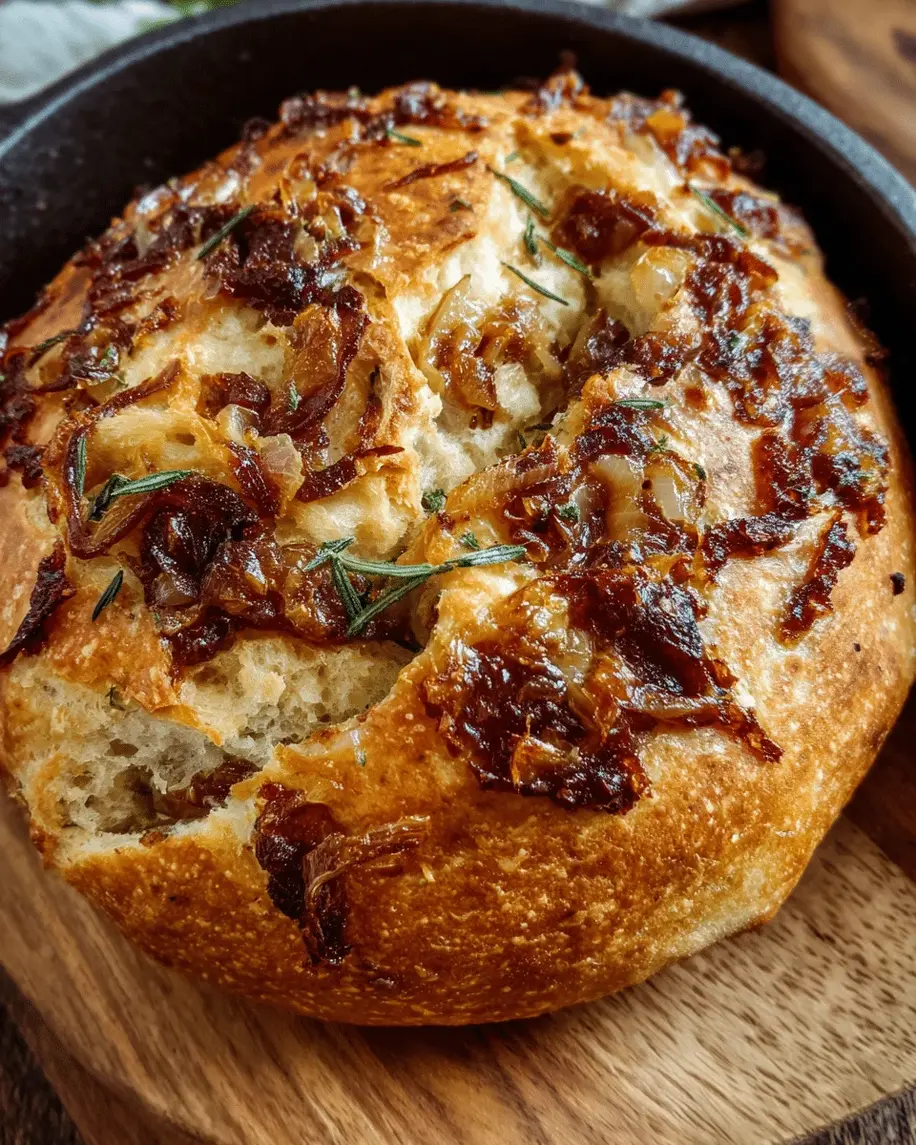
Picture this: a crackling golden crust that shatters under your knife, revealing a soft, tender crumb studded with pockets of melted sharp cheddar and flecks of fragrant rosemary. The caramelized onions weave through every slice, adding a subtle sweetness that balances the tangy sourdough. It’s the kind of bread that turns a simple bowl of soup into a memorable meal, or becomes the base for the best grilled cheese of your life.
What sets this savory sourdough bread with cheese apart is my approach to building layers of flavor. I use a mature sourdough starter for complexity, caramelize the onions low and slow until they’re sticky and jammy, and fold in extra-sharp cheddar for a bold bite. Plus, I’ll share my favorite pro tip for getting an open crumb even with all those add-ins — something that took me years of trial and error to perfect. One common mistake? Adding the onions too wet, which can make the dough heavy. Not today!
Why This Caramelized Onion Cheddar Rosemary Sourdough Bread Recipe Is the Best
The Flavor Secret: My Moroccan roots taught me that caramelization is an art. I cook the onions with butter until they turn a deep mahogany, then deglaze with a splash of water to lift all those dark, sweet bits. Combined with the sharpness of aged cheddar and the piney notes of fresh rosemary, each bite delivers a symphony of tastes — sweet, tangy, savory, and herbaceous. This isn’t your average bread; it’s a centerpiece.
Perfected Texture: Trained in Paris, I learned the importance of dough hydration and handling. This dough is deliberately wet (around 75% hydration) to create an open, airy crumb even with the heavy mix-ins. The caramelized onions and cheese add moisture and richness, but by folding them in gently after the initial knead, I keep the gluten network intact. The result: a crusty exterior with a soft, chewy interior that’s never gummy.
Foolproof & Fast: Yes, artisan bread takes time, but this recipe is designed for home bakers. I use a straight dough method — no autolyse, no complicated folds — just a long, forgiving bulk fermentation that develops flavor while you go about your day. My New York city life taught me efficiency: the onions can be made ahead, the dough can cold-ferment overnight, and the final shape is as simple as a round boule. Even beginners will feel like pros.
Caramelized Onion Cheddar Rosemary Sourdough Bread Ingredients
I source my ingredients from the Union Square Greenmarket and my local Italian specialty shop. The sharp cheddar from a Vermont creamery adds the perfect tang, and the rosemary from my fire escape herb garden (yes, really!) brings a fresh, aromatic punch. These are the building blocks for a loaf that tastes like it took days — but really comes together with love and patience.
Ingredients List
- 1 cup sourdough starter (active and bubbly)
- 1 cup warm water (110°F)
- 3 1/2 cups bread flour
- 1 1/2 teaspoons salt
- 1 large onion, thinly sliced
- 2 tablespoons butter
- 1 cup shredded sharp cheddar cheese
- 2 tablespoons fresh rosemary, finely chopped
- 1 tablespoon olive oil (for hands and bowl)
Ingredient Spotlight
Sourdough Starter: The heart of this rosemary cheddar bread recipe. A mature, well-fed starter gives a tangy depth that complements the sweet onions and sharp cheese. Look for a starter that has doubled in size within 4–6 hours of feeding. If you don’t have one, you can use 1 1/2 teaspoons of active dry yeast dissolved in the warm water, but the flavor won’t be as complex. 💡 mia’s Pro Tip: Keep your starter at peak activity — it should smell fruity and sour, not like acetone.
Sharp Cheddar: I recommend a block of aged white cheddar that you grate yourself. Pre-shredded cheese often contains anti-caking agents that prevent melting. The fat in the cheese enriches the dough and creates pockets of flavor. For a milder loaf, substitute Gruyère or Gouda — both melt beautifully.
Fresh Rosemary: Dried rosemary can be woody and sharp. Fresh rosemary from the produce aisle or your garden (or window box) brings a pine-like, lemony note that cuts through the richness. Chop it finely so it disperses evenly without leaving tough bits.
Bread Flour: King Arthur or any high-protein brand works best. The protein content (11–13%) gives the structure needed for a tall, airy loaf. All-purpose flour can be used but will result in a slightly denser crumb.
| Original Ingredient | Best Substitution | Flavor / Texture Impact |
|---|---|---|
| Sourdough starter | 1 ½ tsp active dry yeast + 1 tbsp sugar | Loses tangy complexity; faster rise |
| Sharp cheddar | Gruyère or smoked Gouda | Smokier or nuttier; still melty |
| Fresh rosemary | Dried rosemary (reduce to 2 tsp) or thyme | Less vibrant; thyme gives earthier note |
| Bread flour | All-purpose flour | Slightly denser crumb, less chew |
How to Make Caramelized Onion Cheddar Rosemary Sourdough Bread — Step-by-Step
Don’t be intimidated by the long rise times — most of it is hands-off. I’ll guide you through each stage with visual cues and chef-approved tips.
Step 1: Caramelize the Onions
In a large skillet over medium-low heat, melt 2 tablespoons of butter. Add the thinly sliced onion and a pinch of salt. Cook, stirring occasionally, for 25–30 minutes until deep golden brown and sticky. Don’t rush — medium-low heat prevents burning. If the pan gets too dry, add a tablespoon of water and scrape up the browned bits. Set aside to cool completely.
💡 mia’s Pro Tip: Cool the onions completely before adding to dough — warm onions can activate the yeast too early and weaken the gluten.
Step 2: Mix the Dough
In a large bowl, combine the sourdough starter, warm water, and 2 cups of bread flour. Stir until smooth — no lumps. Add the salt and the remaining 1 ½ cups of flour, mixing until a shaggy, sticky dough forms. Cover and let rest for 30 minutes (this is called the autolyse, my French trick for better extensibility).
⚠️ Common Mistake to Avoid: Don’t skip the rest — it allows the flour to fully hydrate, making the dough easier to handle later.
Step 3: Knead
Turn the dough onto a lightly floured surface. Knead for 8–10 minutes, adding more flour only as needed (a light dusting). The dough should become smooth, elastic, and slightly tacky but not sticky. You can use the slap-and-fold technique for a more efficient knead.
💡 mia’s Pro Tip: Use a bench scraper to lift and fold the dough — it’s gentler than using your hands and helps incorporate air.
Step 4: Add the Mix-Ins
Flatten the dough into a rectangle. Scatter the cooled caramelized onions, shredded cheddar, and chopped rosemary over the surface. Gently fold the dough over itself like a letter, then knead lightly for 1–2 minutes until evenly distributed. The cheese and onions should be well-incorporated but not breaking the dough’s structure.
⚠️ Common Mistake to Avoid: Overkneading at this stage can burst the cheese pockets and make the dough sticky. Keep it gentle.
Step 5: First Rise (Bulk Fermentation)
Place the dough in an oiled bowl, cover with plastic wrap or a damp towel, and let rise at room temperature (70–75°F) for 4–6 hours until doubled in size. The longer time develops maximum flavor. If your kitchen is cool, it may take up to 8 hours.
💡 mia’s Pro Tip: For even bolder flavor, after the first rise, refrigerate the dough overnight (cold fermentation). This intensifies the sourdough tang and makes the dough easier to handle.
Step 6: Shape and Second Rise
Turn the dough onto a floured surface and gently punch it down. Shape into a tight round boule by pulling the edges into the center and pinching to seal. Place seam-side down on a parchment-lined baking sheet or in a floured banneton. Cover and let rise for another 2–3 hours until puffy and nearly doubled. The dough should spring back slowly when poked.
⚠️ Common Mistake to Avoid: If the dough over-proofs (stays indented when poked), it will collapse in the oven. Stick to the time range and check the poke test.
Step 7: Preheat and Score
About 30 minutes before baking, place a cast iron Dutch oven (or baking stone) in the oven and preheat to 450°F. When ready, carefully remove the hot Dutch oven. Score the top of the dough with a sharp knife or lame — a simple cross or a single deep slash ½ inch deep. This controls where the bread expands (the “oven spring”).
💡 mia’s Pro Tip: Hold the blade at a 45-degree angle to create an “ear” — that beautiful flap of crust that artisan loaves are known for.
Step 8: Bake
Transfer the dough (on the parchment) into the hot Dutch oven. Cover with the lid and bake for 30 minutes. Then remove the lid and bake for another 15–20 minutes until the crust is deep golden brown and the internal temperature reaches 200°F on an instant-read thermometer. The loaf should sound hollow when tapped on the bottom.
⚠️ Common Mistake to Avoid: Don’t peek during the first 30 minutes — the steam inside the covered pot is essential for a crackling crust.
Step 9: Cool
Transfer the bread to a wire rack and let it cool completely before slicing — at least 2 hours. This step is critical: the interior continues to set as it cools, and cutting too early will result in a gummy, sticky crumb.
💡 mia’s Pro Tip: If you can resist, wait until the next day — the flavors meld and the texture becomes even better for toasting.
| Step | Action | Duration | Key Visual Cue |
|---|---|---|---|
| 1 | Caramelize onions | 25–30 min | Deep golden brown, jammy |
| 2 | Mix dough | 5 min + 30 min rest | Shaggy mass |
| 3 | Knead | 8–10 min | Smooth, elastic, tacky |
| 4 | Incorporate mix-ins | 2 min | Evenly distributed |
| 5 | First rise | 4–6 hours | Doubled in size |
| 6 | Shape & second rise | 2–3 hours | Puffy, dimpled on poke |
| 7 | Preheat & score | 30 min | Oven at 450°F, clean slash |
| 8 | Bake | 45–50 min | Deep golden, 200°F internal |
| 9 | Cool | 2+ hours | Firm to touch, no warmth |
Serving & Presentation
This bold flavor artisan bread is a showstopper on any table. I love serving it warm (not hot) with a generous smear of salted butter and a sprinkle of flaky sea salt. The contrast of the crisp crust, the soft interior, and the melty cheese is pure comfort. For a Moroccan twist, try it with a bowl of harira soup — the sweet onions and savory bread soak up the aromatic broth beautifully.
In my NYC apartment, I often serve thick slices alongside a roasted winter squash soup or a classic French onion soup. The bread’s robustness can handle strong flavors — think sharp cheeses, hearty stews, or even a simple salad of arugula and shaved Parmesan. It also makes incredible croutons: cube leftover bread, toss with olive oil and garlic, and bake at 375°F for 10 minutes.
For a beautiful presentation, slice the loaf in half lengthwise and toast the cut sides on a grill pan. Top with melty Brie, caramelized onions, and a drizzle of honey — a quick appetizer that wows guests. I learned this trick at a Parisian bistro, and it never fails.
| Pairing Type | Suggestions | Why It Works |
|---|---|---|
| Side Dish | Roasted tomato soup, beef stew, lentil soup | Sweet onion and cheese complement rich broths |
| Sauce / Dip | Herbed olive oil, balsamic reduction, honey butter | Adds brightness or sweetness against savory bread |
| Beverage | Pinot Noir, amber ale, Moroccan mint tea | Earthy wine, malty beer, or refreshing tea cleanse the palate |
| Garnish | Flaky salt, fresh thyme sprigs, extra rosemary | Enhances herbaceous notes and visual appeal |
Make-Ahead, Storage & Reheating
Living in New York means I’m always meal-prepping. This artisan sourdough bread recipe is perfect for making ahead — the flavors only get better. I often prepare the caramelized onions on Sunday, mix the dough Monday morning, and bake Tuesday afternoon. Here’s how to keep your loaf fresh and delicious.
| Method | Container | Duration | Reheating Tip |
|---|---|---|---|
| Refrigerator | Plastic bag or beeswax wrap | Up to 5 days | Wrap in foil, warm at 350°F for 10 min |
| Freezer | Double layer of plastic wrap + foil | Up to 3 months | Thaw at room temp then re-crisp in oven |
| Make-Ahead | Covered bowl in fridge | Up to 2 days (after first rise) | Shape and proof cold, then bake as directed |
To reheat from frozen, I slice the bread while still slightly frozen, then toast directly in a toaster or under the broiler. For a whole loaf, wrap in foil and bake at 350°F for 15–20 minutes until warmed through. The crust will regain its crunch. Avoid the microwave — it turns the crust rubbery and steams the cheese.
If you plan to enjoy the bread over several days, store it cut-side down on a wooden cutting board with a cloth napkin draped over. This keeps the crust crisp and the crumb moist. Never store bread in the fridge (unless it’s already sliced) — the cold accelerates staling.
Variations & Easy Swaps
| Variation | Key Change | Best For | Difficulty Impact |
|---|---|---|---|
| Moroccan Spiced | Add 1 tsp cumin + ½ tsp cinnamon + ¼ tsp cayenne | Adventurous palates, tagine side dish | Same |
| Dairy-Free / Vegan | Use vegan butter, omit cheese or use vegan cheddar | Dairy-free diets | Same (cheese texture will vary) |
| Caramelized Shallot & Thyme | Replace onion with 3 large shallots, use thyme instead of rosemary | Milder, sweeter flavor | Same |
Moroccan Spiced Version
Inspired by my childhood, I sometimes add a Moroccan touch: toast 1 teaspoon of cumin seeds and ½ teaspoon of cinnamon along with the caramelized onions. The warmth of the spices pairs beautifully with the sharp cheddar and rosemary — it’s like a stroll through the Marrakech souk. Sprinkle a pinch of cayenne if you like heat. This variation turns the bread into a companion for lamb stews or roasted carrots.
Dairy-Free / Vegan Version
For my dairy-free friends, swap the butter with vegan butter or olive oil for caramelizing, and omit the cheddar entirely. The bread will be less rich but still deliciously savory. You can add ¼ cup of nutritional yeast for a cheesy flavor, or use a store-bought vegan cheddar shred — just check that it melts well. The texture will be slightly denser, so I recommend adding an extra tablespoon of water to the dough.
Caramelized Shallot & Thyme Variation
When I find beautiful, large shallots at the Union Square market, I love using them instead of onions. Their natural sweetness is more delicate, and they caramelize faster (about 20 minutes). Swap the rosemary for fresh thyme — 2 tablespoons of leaves. The result is a more elegant, subtly sweet bread that pairs wonderfully with goat cheese or as a base for canapés at a cocktail party.
How do you caramelize onions for sourdough bread without burning them?
Caramelizing onions is all about patience and low heat. Use a heavy-bottomed skillet (cast iron is ideal) over medium-low heat, and add a generous pat of butter or a mix of butter and olive oil. Slice the onions thinly and evenly so they cook uniformly. Stir every 5–7 minutes, scraping up any browned bits from the bottom. If the pan seems dry, add a tablespoon of water – this deglazes the pan and prevents burning. The process should take 25–30 minutes for a deep golden brown color. For this caramelized onion cheddar rosemary sourdough bread, let the onions cool completely before adding to the dough; warm onions can disrupt the yeast activity.
Can I use a different cheese instead of cheddar in this rosemary sourdough recipe?
Absolutely! Cheddar gives sharp, tangy notes, but you can substitute with Gruyère for a nuttier, meltier result, or smoked Gouda for a subtle smokiness that complements the rosemary. If you want a milder flavor, try Monterey Jack or fontina. Hard cheeses like Parmesan can be used in smaller amounts (½ cup) for a more intense umami kick. Just keep in mind that different cheeses have different moisture levels – wetter cheeses (like fresh mozzarella) may make the dough sticky, so reduce the water slightly. Always shred cheese yourself to avoid anti-caking agents.
What is the best way to incorporate caramelized onions into artisan bread dough?
The key is to let the onions cool completely before adding them – I even pat them dry with a paper towel to remove excess moisture. Add them after the initial knead but before the first rise. Flatten the dough into a rectangle, scatter the onions (along with cheese and herbs) over the surface, then fold the dough over itself like an envelope. Knead gently for 1-2 minutes to distribute evenly. Overworking the dough at this stage can deflate it and make the add-ins clump. The cool, dry onions incorporate smoothly without breaking down the gluten.
How long should you let this sourdough bread rise for the boldest flavor?
For the boldest flavor, I recommend a long, slow first rise (bulk fermentation) of 4–6 hours at room temperature (70–75°F). Even better: after that rise, refrigerate the dough overnight (8–12 hours) for a cold ferment. The cold slows down yeast activity but allows enzymes and bacteria to continue developing complex, tangy flavors. The second rise after shaping should be 2–3 hours at room temperature. If you use the overnight cold ferment, you can skip the second rise at room temp and bake directly from the fridge after a 30-minute tempering.
Can I make this bread with all-purpose flour instead of bread flour?
Yes, you can substitute all-purpose flour, but the crumb will be slightly denser and less chewy since all-purpose has lower protein content (about 10-11% vs bread flour’s 12-14%). To compensate, you can add 1 tablespoon of vital wheat gluten per cup of flour to boost structure. Alternatively, use half bread flour and half all-purpose. For the best results in this artisan sourdough bread recipe, I stick with bread flour for that open crumb and crisp crust.
Why is my sourdough bread dense and not rising properly?
Common culprits include a weak starter, insufficient kneading, or under-proofing. Make sure your starter is active and bubbly – it should double in size within 4-6 hours of feeding. If your dough doesn’t noticeably increase during bulk fermentation, the starter may be the issue. Also, check your water temperature: too cold (below 70°F) slows down fermentation, too hot (above 120°F) kills the yeast. Finally, don’t skimp on kneading – 8-10 minutes of proper kneading develops the gluten network needed to trap gas bubbles.
How do I get a crispy crust on my sourdough bread?
A crispy crust requires steam during the initial baking phase. Baking in a preheated Dutch oven with the lid on traps steam from the dough, creating a humid environment that allows the crust to stay soft and expand. After 30 minutes, remove the lid to let the crust dry out and turn golden and crackly. You can also create steam by placing a pan of hot water on the bottom rack of the oven. For extra crunch, brush the loaf with an ice cube dissolved in water just before baking – the cold water creates a burst of steam.
Can I add other herbs or spices to this savory sourdough bread?
Definitely! The base recipe is very versatile. Try adding 1 teaspoon of dried oregano, ½ teaspoon of garlic powder, or even 1 tablespoon of za’atar for a Middle Eastern twist. Fresh thyme, chives, or dill work beautifully with the caramelized onions. Just be mindful of strong flavors – start with 1-2 teaspoons of dried herbs. For a spicy kick, add ½ teaspoon of red pepper flakes or a pinch of smoked paprika. Experiment and make it your own – that’s the joy of bold flavor artisan bread.
Share Your Version!
I love seeing how you make this caramelized onion cheddar rosemary sourdough bread your own. Did you add a pinch of sumac? Swap cheddar for Gruyère? Bake it in a different shape? Drop a comment below and let me know – include any tweaks you made, and I’ll feature the most creative ones on my Instagram stories! Also, if you’re on Pinterest, don’t forget to pin this recipe and tag @exorecipe so I can cheer you on.
One question I always ask: what’s the first thing you’ll spread on this bread? For me, it’s always salted butter and a drizzle of honey – a nod to both my Moroccan side and the French love of simple pleasures. From my NYC kitchen to yours — I hope this recipe brings as much warmth to your table as it does to mine. — mia 🧡
Love This Recipe? Save It to Pinterest!
If you enjoyed this Caramelized Onion, Cheddar & Rosemary Sourdough Artisan Bread recipe, don’t let it get lost in your browser tabs! 😄 Pin it now so you can find it again anytime — and explore hundreds more tried-and-tested recipes waiting for you on my Pinterest boards.
👉 Follow mia on Pinterest @exorecipe
📌 Pin this recipe · 🔁 Re-pin your favorites · 💬 Tag me when you make it — I love seeing your creations!
🔥 Loved this recipe? Pin it, share it, and let me know how it turned out!
I read every comment – can’t wait to see your beautiful loaves! 🤍